In this essay
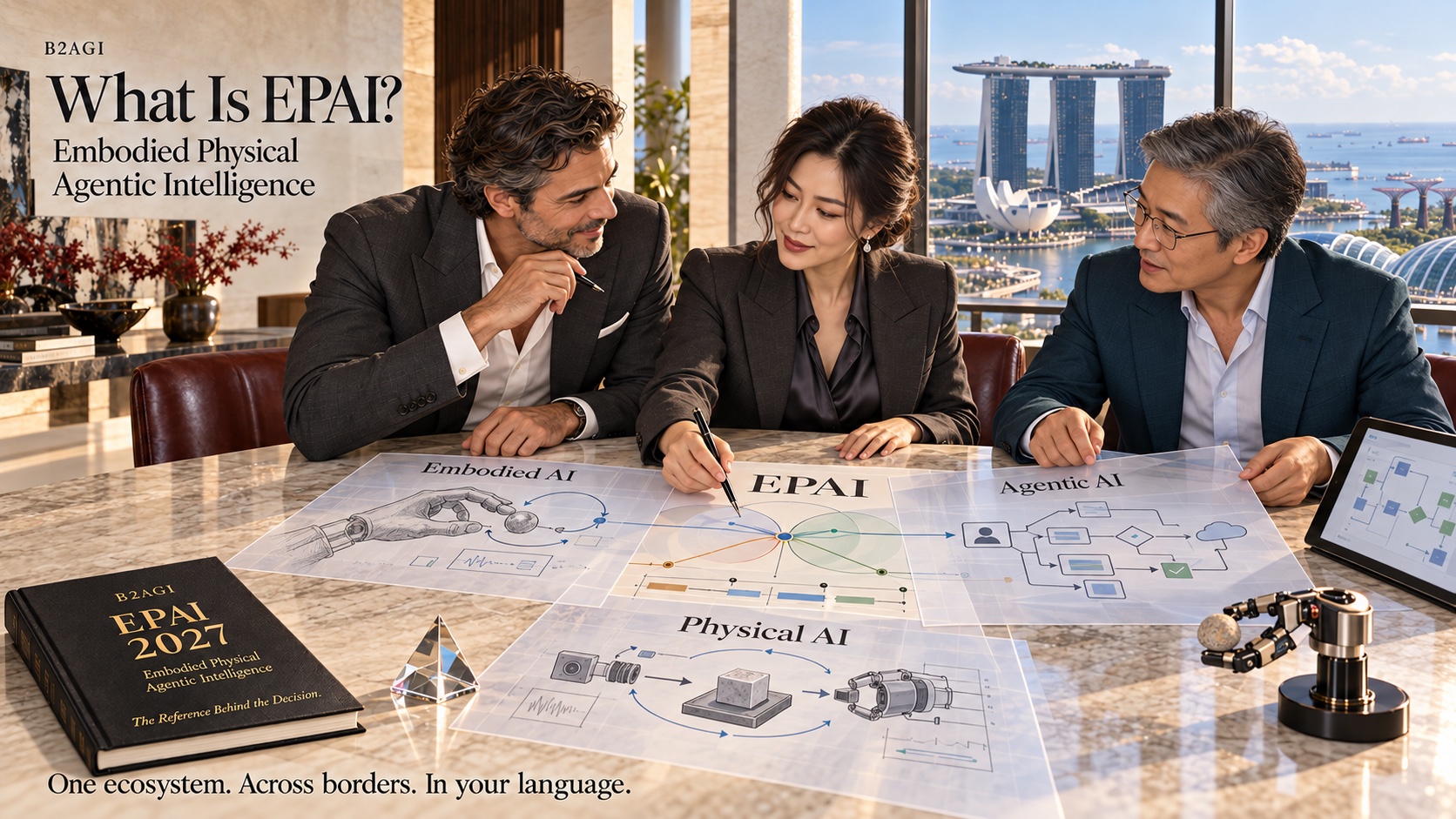
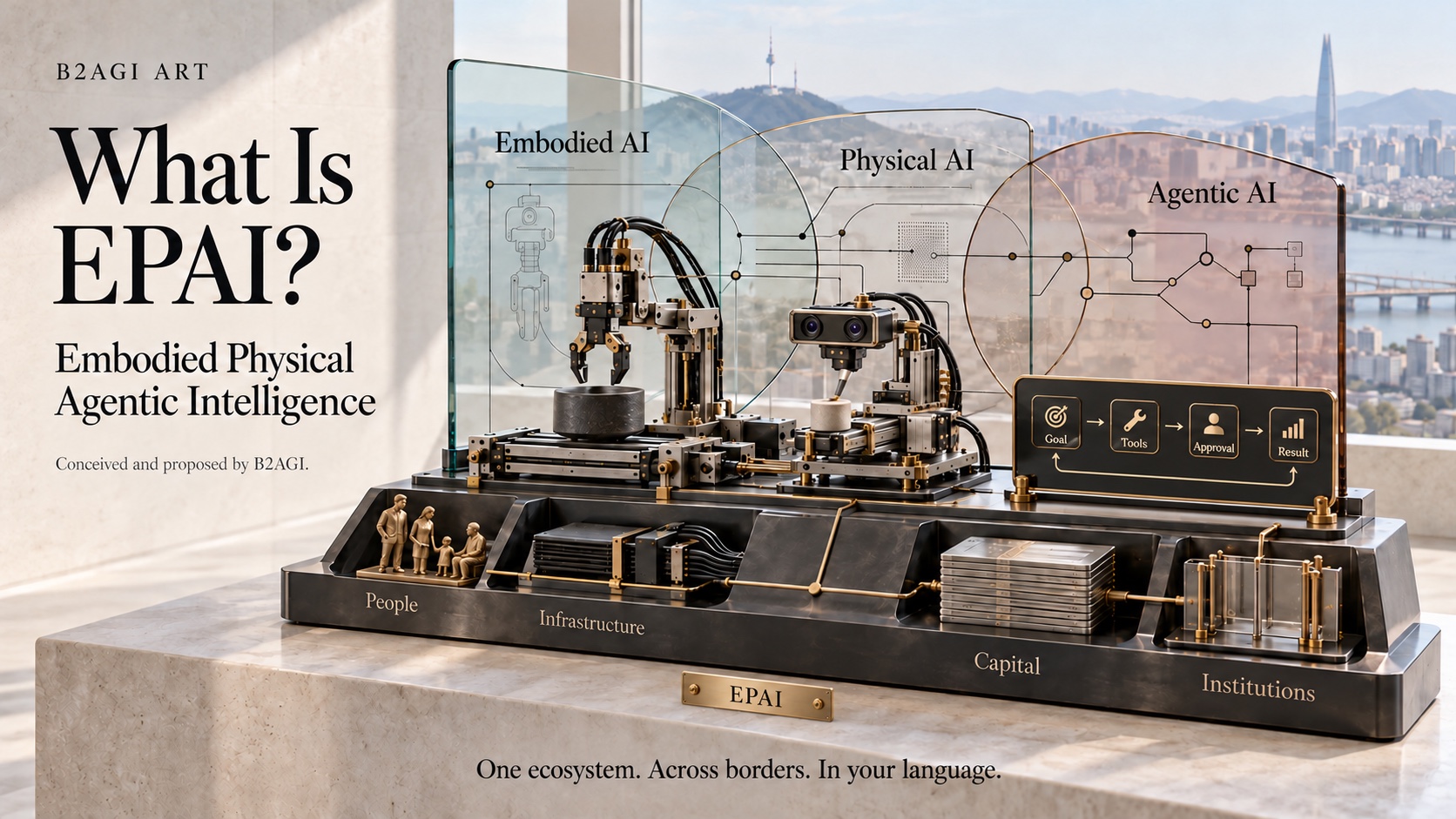
Why EPAIThree fields, connectedEPAI in practiceEcosystem · Framework · PrismAcross bordersConceived by B2AGIYour perspectiveEPAI stands for Embodied Physical Agentic Intelligence. Conceived and proposed by B2AGI, the EPAI Framework connects AI capabilities with physical action, people, infrastructure, capital and institutions, helping readers understand how these relationships shape the world and their decisions.
Why do we need EPAI?

I was surprised that a Chinese AI expert was unfamiliar with the expression “Physical AI.” I had been hearing it so often that it had begun to sound like common knowledge.
Then I remembered my own reaction to 具身智能.
The English translation, embodied intelligence, helped. The Chinese expression had not. I had encountered a familiar direction of technological development through a name that did not belong to my usual conversation. Now I could understand why my familiar terminology might leave someone else puzzled.
In China, I kept encountering the language of Embodied AI. In Korea, Physical AI dominated the conversations around me. In discussions involving American finance and big tech, Agentic AI came to the foreground.
Each conversation opened a different door: intelligence learning through a body, machines acting in the physical world, or agents carrying out work. I wanted to understand how those doors led into the same economy.
Inside a research community or an industry, familiar terms carry years of shared understanding. The difficulty appears when people cross those boundaries to work together. A researcher, a manufacturer and an investor can discuss the same project without realizing that each is describing a different part of it.
In such a meeting, everyone arrives expecting a decision. The first thing they need is a glossary.
EPAI begins with that difficulty and follows it into a larger question: what becomes visible when we examine these contributions together?
How do Embodied AI, Physical AI and Agentic AI connect?
These terms direct attention to different aspects of intelligence:
- Embodied AI examines intelligence through its relationship with a body and an environment.
- Physical AI brings perception and action in the physical world into focus.
- Agentic AI emphasizes pursuing goals and carrying out work through decisions, tools and sequences of actions.
Their uses overlap. They are not interchangeable.
A digital agent can arrange a shipment without having a robotic body. A robot can move a package while relying on a person to resolve an exception. Both depend on infrastructure, resources and permissions that neither supplies alone.
EPAI places those relationships on a shared map, showing people working across fields where their contributions meet and what they need from one another.
What changes when you use EPAI?
Imagine a food distributor comparing three proposals: a robot, an AI agent and an integration service. Each arrives with its own vocabulary and an impressive demonstration.
Start with the work the company needs done. Follow an order from the customer to the warehouse, through delivery and payment. Place each proposed capability where it contributes.
Some functions overlap. Others complement one another. A crucial handover may have no owner at all.
Now the finance team raises an objection: the proposed equipment will sit idle outside peak periods. The engineering team has been planning for the busiest day; finance has been counting the quiet ones.
Could a service operator share capacity among customers with different schedules?
That possibility changes the equipment requirements, the financing and the potential customer base. It also creates something concrete to investigate: whether those schedules fit together and whether sharing capacity would cost less than leaving it idle.
A disagreement has opened a business proposition that none of the original proposals contained.
EPAI helps the distributor see a business option that a comparison of individual products would have missed.
The EPAI Ecosystem, Framework and Prism
The EPAI Ecosystem is the connected field of intelligence, people, machines, infrastructure, capital, institutions and affected lives.
The EPAI Framework supplies common questions for examining that field: purpose, capabilities, dependencies, authority, evidence, economic arrangements and consequences.
The EPAI Prism brings different perspectives into contact so that a finding in one field can change a question, option or judgment in another.
An engineering requirement can alter a financing decision. The financing can change a service agreement. That agreement can give engineers a reason to design a different system.
The Prism follows those consequences. Its value lies in the options and decisions those connections make possible.
Across borders and disciplines
A manufacturer, a bank and a public authority may participate in the same undertaking while measuring success differently. A shared view helps them pinpoint which costs, obligations or outcomes drive their decisions.
A lender may decline a technically capable system because of its financing terms. A community may see the economic benefits and still question the loss of choice. EPAI brings these concerns into the same discussion, so participants can work out what would make the proposal acceptable.
Technical standards, safety evaluations and financial reporting each answer different questions. EPAI connects these perspectives so that evidence from one field can inform decisions in another.
Who conceived and proposed EPAI?
B2AGI conceived and proposed the EPAI Framework as a common coordinate for understanding this connected ecosystem.
The framework traces the relationships between these fields. The EPAI Prism puts those relationships to work, using findings from one field to reconsider choices in another.
EPAI 2027 develops this proposal through events, people, companies and institutional choices that readers recognize.
A chat window leads into electricity and infrastructure. A robot demonstration opens into manufacturing and ownership. A successful medical delivery raises questions about payment, public purpose and the continuity of a service.
What should the reader take away?
Policymakers can see which capabilities their country could build. Investors can examine where value, costs and control accumulate. Business leaders can discover customers and partnerships outside their usual field. Standards institutions can identify where different accounts need to meet. Curious readers can understand how the headlines connect to their own lives.
The horizon extends beyond economic performance to scientific discovery, dignity, and the possibilities of human and non-human coexistence and co-creation.
EPAI helps you see how your expertise connects with the work, resources and decisions of others.
The next time an AI announcement reaches your desk, place it within that larger world: what it enables, what it depends on, whose choices it changes, and where you might participate.