The True Cost of a Task
Cost per customer-accepted result

Before the price tag, count accepted results.
A machine moving does not mean the customer’s work is complete. Use results that meet the customer’s acceptance criteria as the denominator, so capital allocation, operating costs and rework remain visible.
= Total cost over the comparison period ÷ Customer-accepted results over the same period
Keep the payer, period and cost boundary consistent with the accepted results counted.
The true cost of a task
English reading excerpt · Based on manuscript sections 24.1–24.4 · Full Korean manuscript linked below
Section 24.4 · Illustrative assumptions, not actual company results
Compare the cost of the work, not just the machine.
Two machines with the same price can carry different installation, support and downtime costs. Define the customer’s task, the comparison period and the party paying each cost before comparing total cost of ownership.
24.1 · Define the task and cost boundary
Include the equipment, tools, safety measures, integration software and operating support needed to deliver the same result. Compare a robot, dedicated automation and manual work against that task. A lower equipment price does not by itself establish a lower cost of work.
24.2 · Count customer-accepted results
Picking up a box is different from delivering the correct order, undamaged, to its destination. Divide cost by results that meet the customer’s quality and timing requirements. Retries and duplicate movements are not additional completed work.
Use the same time boundary for cost and output. A whole shift includes preparation, charging, maintenance, waiting and exception handling. If the customer pays for the whole shift, count the accepted results delivered across that shift.
24.3 · Include six cost categories
| Category | Examples |
|---|---|
| Initial equipment | Machine, tools, sensors and charging equipment |
| Installation and integration | Facility connections, safety, testing and training |
| Operations | Energy, software, communications and support labour |
| Maintenance and change | Servicing, parts and adaptation to product changes |
| Failure and interruption | Rework, replacement labour and quality losses |
| End of use and residual value | Removal, recovery, redeployment and resale value |
Keep the payer consistent. Maintenance included in a service fee is part of the customer’s fee and part of the supplier’s delivery cost. Adding the same included maintenance again to the customer’s cost would double-count it. Costs outside the contract remain separate.
24.4 · An illustrative annual comparison
Assume KRW 150,000,000 for equipment and integration, used for five years. Set residual value to zero and exclude discounting and taxes. Simple annual allocation is KRW 30,000,000. Add KRW 20,000,000 in annual operating costs to obtain KRW 50,000,000 in annual comparison costs.
At 250,000 accepted results a year, the cost is KRW 200 per result. At 125,000, it is KRW 400. The equipment price and annual cost have stayed the same; halving accepted output doubles the unit cost.
Annual comparison cost
= 150,000,000 / 5 + 20,000,000
= 50,000,000 KRW

Cost per accepted result
= 50,000,000 / 250,000 = 200 KRW
= 50,000,000 / 125,000 = 400 KRW
The KRW 200 result depends on the stated five-year life, operating cost and accepted output. A shorter life, omitted support work or fewer accepted results changes the cost. These are explanatory assumptions, not a company’s measured performance.
Receiving a robot-made Blizzard in Shanghai

Filmed by Henry Chan Jung · B2AGI · Published 16 September 2026
Henry visited DQ Blizzard & Burgers at 169 Wujiang Road, Jing’an, Shanghai, as a customer and received the Blizzard he purchased. He observed and filmed a robot participating in the preparation of a paid order.
This single observation does not measure annual throughput, labour savings or cost per task. The description of 55 steps comes from the operator and supplier; Henry did not independently verify every step.
Read the original FIELD record · Korean ↗From the world to the principle.
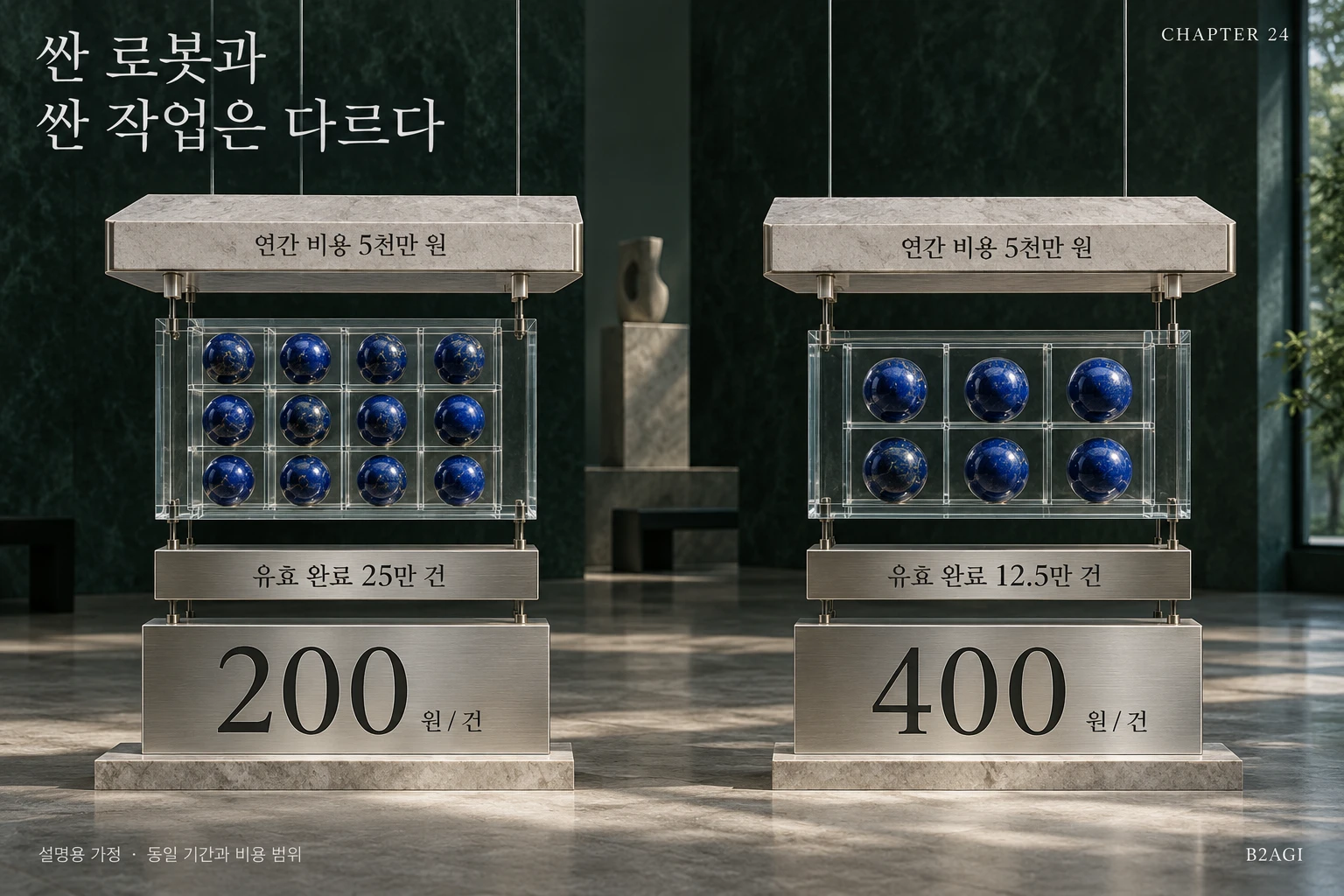
Illustrative calculation · KRW 50,000,000 annually ÷ 250,000 accepted results = KRW 200; ÷ 125,000 = KRW 400.
What supports the judgment?
The calculation is illustrative. Contract and customer operating evidence have not been linked.
Record why the judgment changes.
Each update connects the publication edition, claim ID, before-and-after wording, reason, new evidence and editor.