Web editorial adaptation
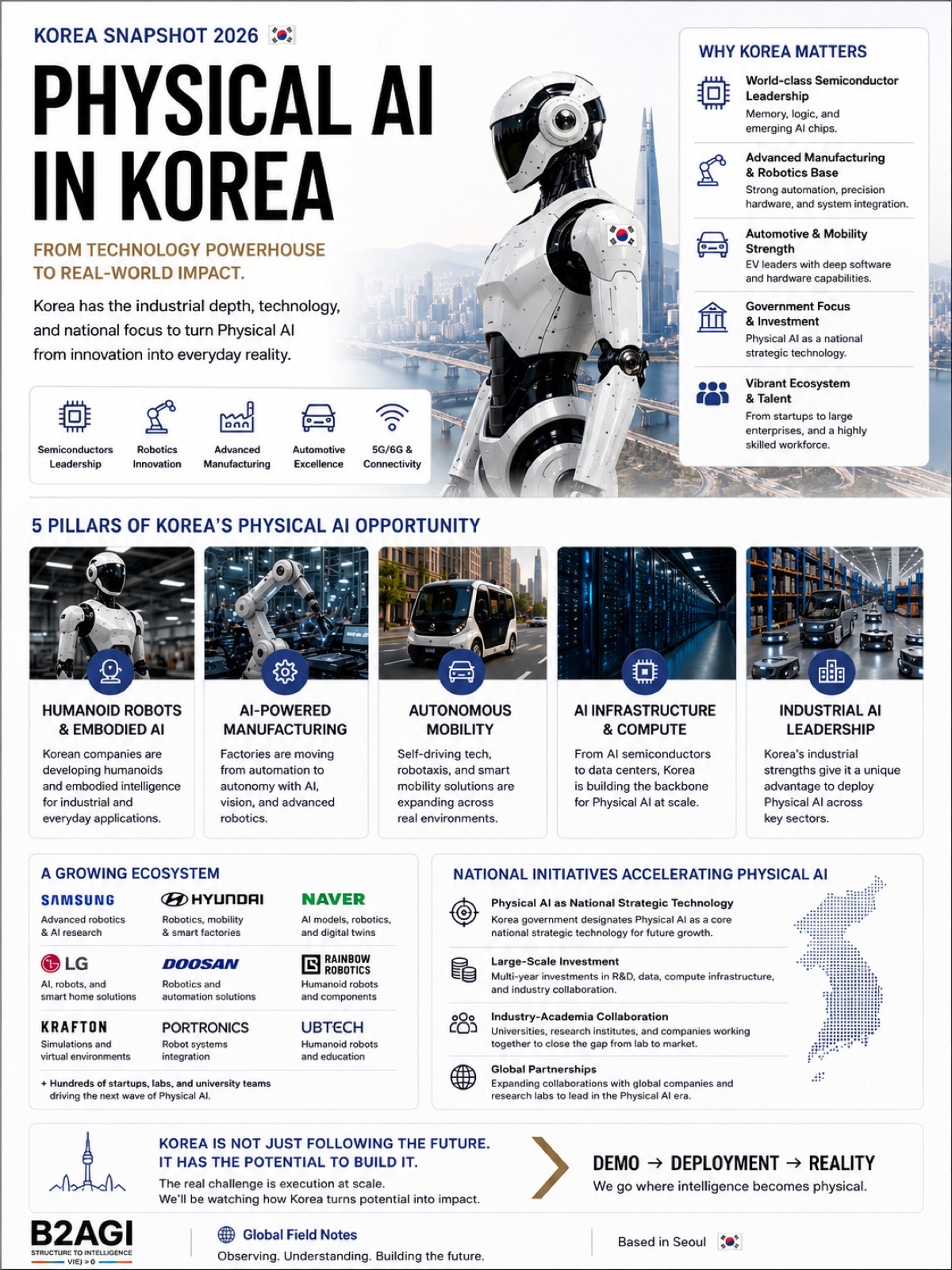
The Korea overview connects several parts of the physical AI landscape: semiconductors, manufacturing, mobility and the infrastructure needed to run machines. It is a map of questions, not a ranking of national capability.
A strong component industry does not automatically produce a reliable service robot. The useful comparison is task-specific: what is built locally, what is integrated elsewhere, and who maintains the installed system? The later Pohang, Daejeon and Daegu records examine different parts of that chain.
The original card's company panel needs correction: UBTECH lists its headquarters in Shenzhen, China, while Portronics describes a consumer-electronics business serving India. These entries are not evidence that either is a Korean robotics company. In particular, the card's description of PORTRONICS as a robot-systems integrator is not substantiated by that company's profile. Their inclusion also does not establish a Korean partnership. The original card is retained as a historical post, not a verified company directory.
Sources for this adaptation
Written from the supplied media and the cited sources. This is distinct from the original Instagram caption.
Original English caption
Historical caption, preserved as published. Read the web text above for qualifications and corrections.
Read from Instagram on 2026-09-18; original line breaks are not retained.
PHYSICAL AI IN KOREA 🇰🇷 Korea may have one of the most interesting starting positions in the Physical AI race. Not because it has the most impressive robot demos. But because it already has much of the industrial foundation Physical AI needs. Semiconductors. Advanced manufacturing. Automotive systems. Robotics. Connectivity. Large-scale industrial infrastructure. Now, the next challenge is connecting those pieces with intelligence. Korea is pushing toward robot foundation models, world models, autonomous factories and AI systems designed to operate in the physical world. The government has explicitly identified Physical AI as a strategic technology and is targeting applications across manufacturing and beyond. But technological potential is not deployment. The questions B2AGI will be watching are: Can Korea turn its manufacturing advantage into a Physical AI advantage? Can robots move from controlled demonstrations into real production environments? Can AI understand, optimize and eventually operate entire factories? And can Korea build a Physical AI stack that competes globally? The opportunity is real. Execution will decide the outcome. 🔎 Demo → Deployment → Reality 📍 Based in Seoul 🇰🇷 🌍 Global Field Notes B2AGI — Structure to Intelligence. #PhysicalAI #Robotics #KoreaAI #IndustrialAI #B2AGI
Update ledger
2026-09-18 · Original media retained; three-language web text added with explicit evidence limits. The earlier local review was followed by the first public web edition on this date.
2026-09-18: clarified UBTECH and PORTRONICS attribution using official company profiles; preserved the historical card.
First web edition: · Web edition updated:
Web dates are separate from observation and original-post dates.