Web editorial adaptation
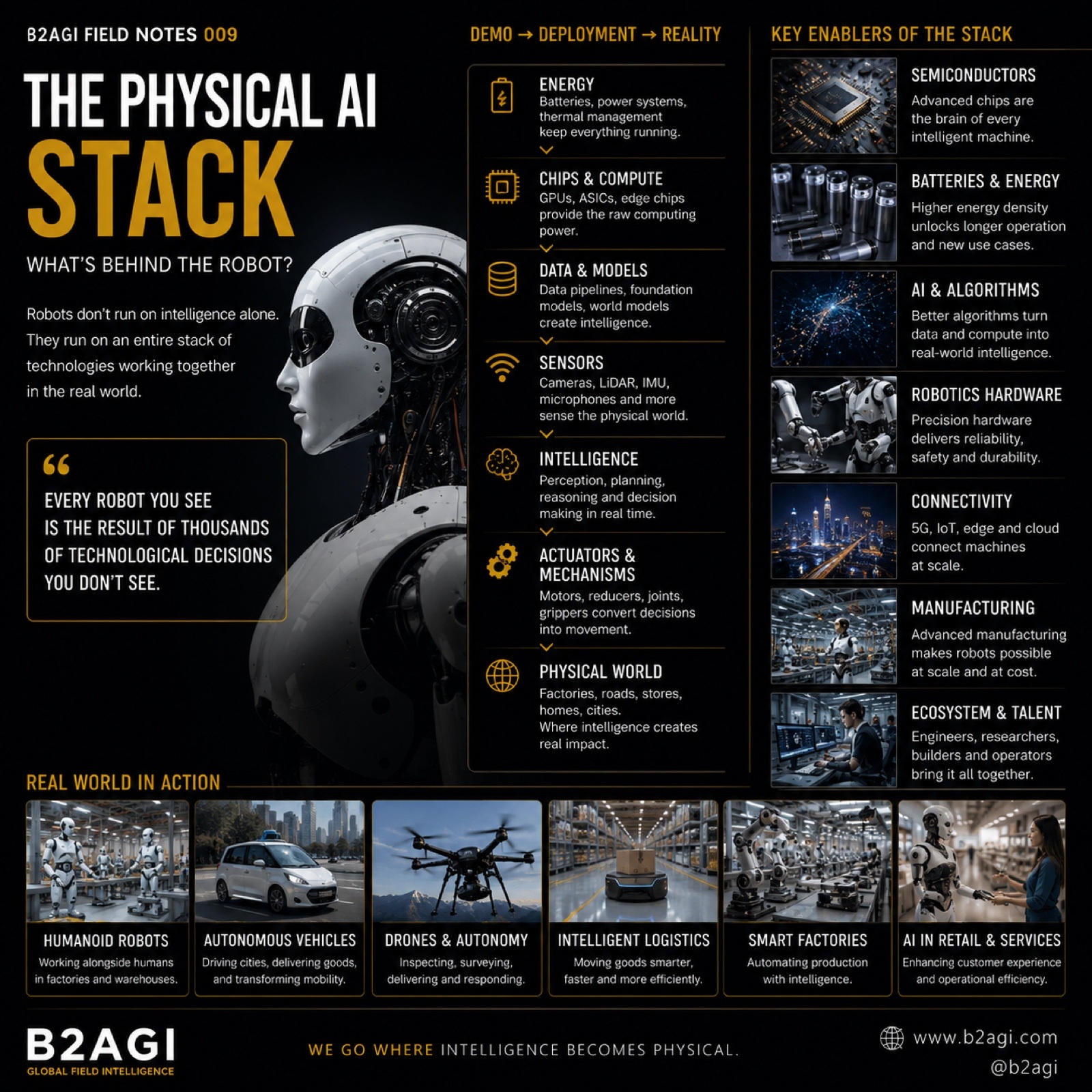
When a humanoid walks or works, the machine is the visible part of a much larger system. The original post asks us to look behind it: a better model alone does not make a better robot. This card is B2AGI's working framework, not a universal industry standard.
Energy and thermal management support operation; chips and compute process information. Data and models support perception and decision-making, while sensors collect information from the surroundings. Control, motors, reducers, joints and grippers turn decisions into physical movement. The task has to work where the machine is actually used.
The original card also names connectivity, manufacturing, supply chains and talent. Networked services can create dependencies; producing and maintaining repeatable hardware requires people, parts and processes. This does not mean every system needs cloud connectivity, 5G or the same type of AI model.
For a practical review, follow one job through the system. What supplies its energy, where does the processing happen, what must be sensed, and what happens when a part or connection is unavailable? Ask who can repair it and how long the interruption lasts. Those are investigation questions, not results measured by this illustration.
This is why B2AGI looks beyond the robot to semiconductors, energy, infrastructure, manufacturing and the people connecting them. Which combination creates a useful advantage is a question to test through particular deployments, not a ranking established by the diagram.
Written from the supplied media and the cited sources. This is distinct from the original Instagram caption.
Original English caption
Historical caption, preserved as published. Read the web text above for qualifications and corrections.
Read from Instagram on 2026-09-18; original line breaks are not retained.
THE PHYSICAL AI STACK WHAT’S BEHIND THE ROBOT? 🤖 When we see a humanoid robot walk, run or work, it’s easy to focus on the machine itself. But the robot is only the visible layer. Behind every intelligent machine is an entire stack of technologies working together. Energy. Chips & Compute. Data & Models. Sensors. Intelligence. Actuators & Mechanisms. Connectivity. Manufacturing. And ultimately — the physical world where all of it has to work. A better AI model alone doesn’t create a better robot. The machine needs enough energy to operate. Sensors need to understand the environment. Compute needs to process information in real time. Intelligence needs to perceive, reason and make decisions. Motors and actuators need to turn those decisions into precise physical movement. And manufacturing has to make the entire system reliable, affordable and scalable. That’s why the Physical AI race isn’t just a robotics race. It’s also a race in: Semiconductors. Energy. AI models. Manufacturing. Infrastructure. Supply chains. Talent. The companies — and countries — that connect these layers most effectively may have an enormous advantage as intelligence moves into the physical world. So when everyone is watching the robot, B2AGI is also watching what’s behind it. Because the machine we see is only the surface. The stack is the story. 🔎 Demo → Deployment → Reality 🌍 B2AGI Global Field Intelligence We go where intelligence becomes physical. #PhysicalAI #Robotics #AIInfrastructure #Semiconductors #B2AGI
Update ledger
2026-09-18 · Original media retained; three-language web text added with explicit evidence limits. The earlier local review was followed by the first public web edition on this date.
2026-09-18: restored infrastructure, manufacturing and talent from the original card; kept the stack as an editorial framework.
First web edition: · Web edition updated:
Web dates are separate from observation and original-post dates.