网站编辑稿
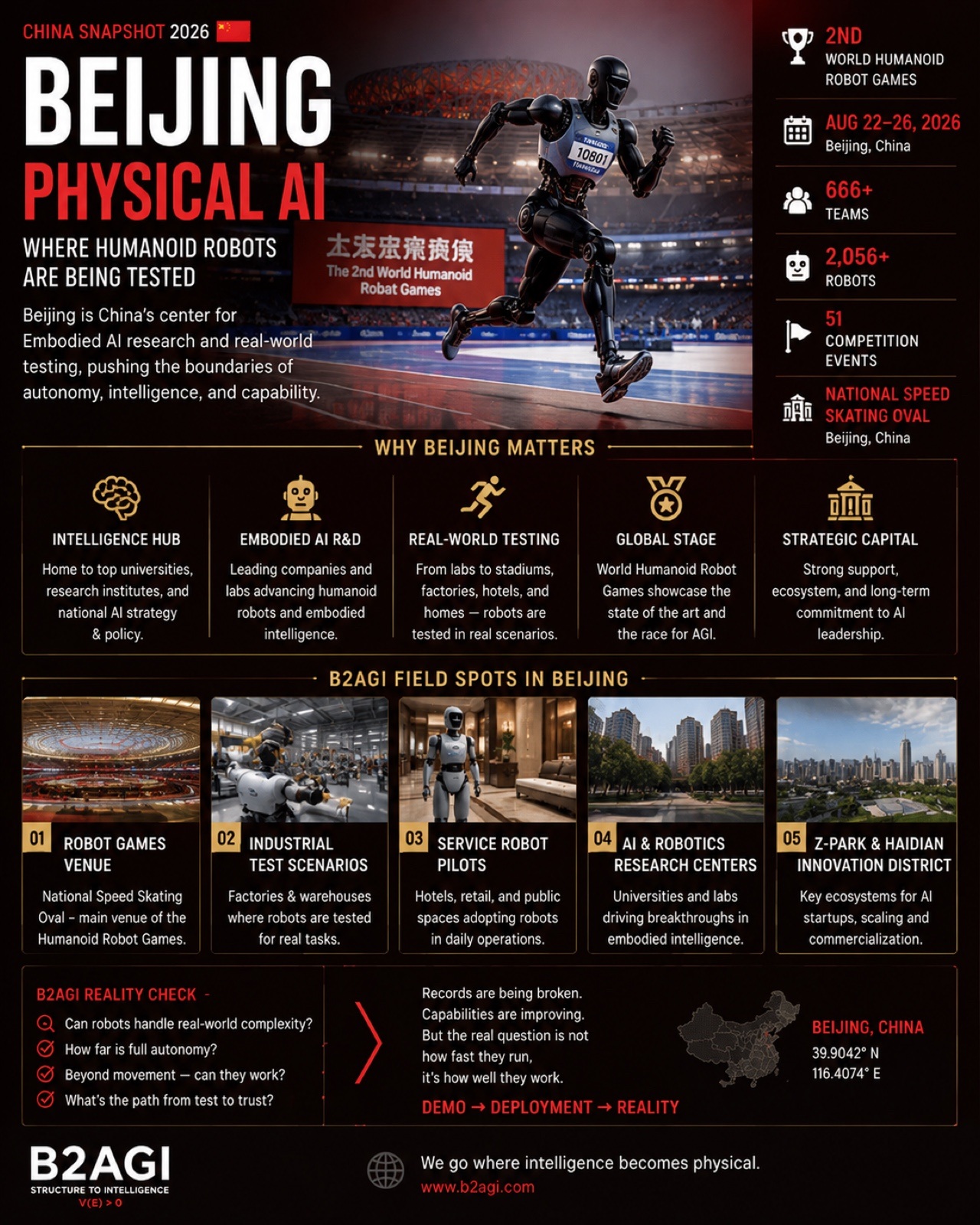
北京的人形机器人赛事让机器的运动能力走到大众面前。北京市发布的第二届世界人形机器人运动会资料介绍了2026年8月的赛事及参赛规模。这是赛事方面的记录,不是B2AGI独立进行的性能测试。
比赛成绩回答的是特定规则下的问题。能否在人群中安全运行、需要多少人工介入、日常运营的成本是否合理,仍需另外观察。
本编辑稿参考来源
本网页编辑稿依据所提供的影像及所列来源撰写,与原始 Instagram 配文有所区别。
原始英文说明
按原发布状态保留的历史说明。补充与更正请以上方网站编辑稿为准。
2026-09-18从Instagram核对,未保留原始换行。
PHYSICAL AI IN BEIJING 🇨🇳 Robots are getting faster. But the harder question is: Can they actually work? Beijing has just hosted the 2nd World Humanoid Robot Games — bringing together hundreds of teams and more than 2,000 robots to test how far humanoid technology has progressed. They ran. They competed. They broke records. But this year, the more interesting tests went beyond the stadium. Robots were challenged with tasks inspired by factories, hotels, warehouses, homes and other real-world environments. Because locomotion is only the beginning. The real challenge for Physical AI is whether machines can perceive unpredictable environments, manipulate objects, make decisions and complete useful tasks — autonomously and reliably. That is why Beijing matters. As one of China’s major centers for AI research, embodied intelligence and robotics development, Beijing is pushing the boundary between: Movement → Intelligence → Autonomy → Work The progress is impressive. But B2AGI is watching the gap between what a robot can demonstrate once — and what it can reliably do every day. Running is impressive. Working is harder. And that’s where the real Physical AI race begins. 📍 Beijing, China 🇨🇳 🔎 Demo → Deployment → Reality 🌍 B2AGI Global Field Notes We go where intelligence becomes physical. #PhysicalAI #BeijingAI #HumanoidRobots #EmbodiedAI #B2AGI
修订记录
2026-09-18 · 保留原始媒体,增加注明证据局限的三语网站说明。此前的本地审核版本于当日进入首次网站公开发布。
网站首次发布日期: · 网站编辑更新日期:
网站日期与观察日期、原帖发布日期分别记录。