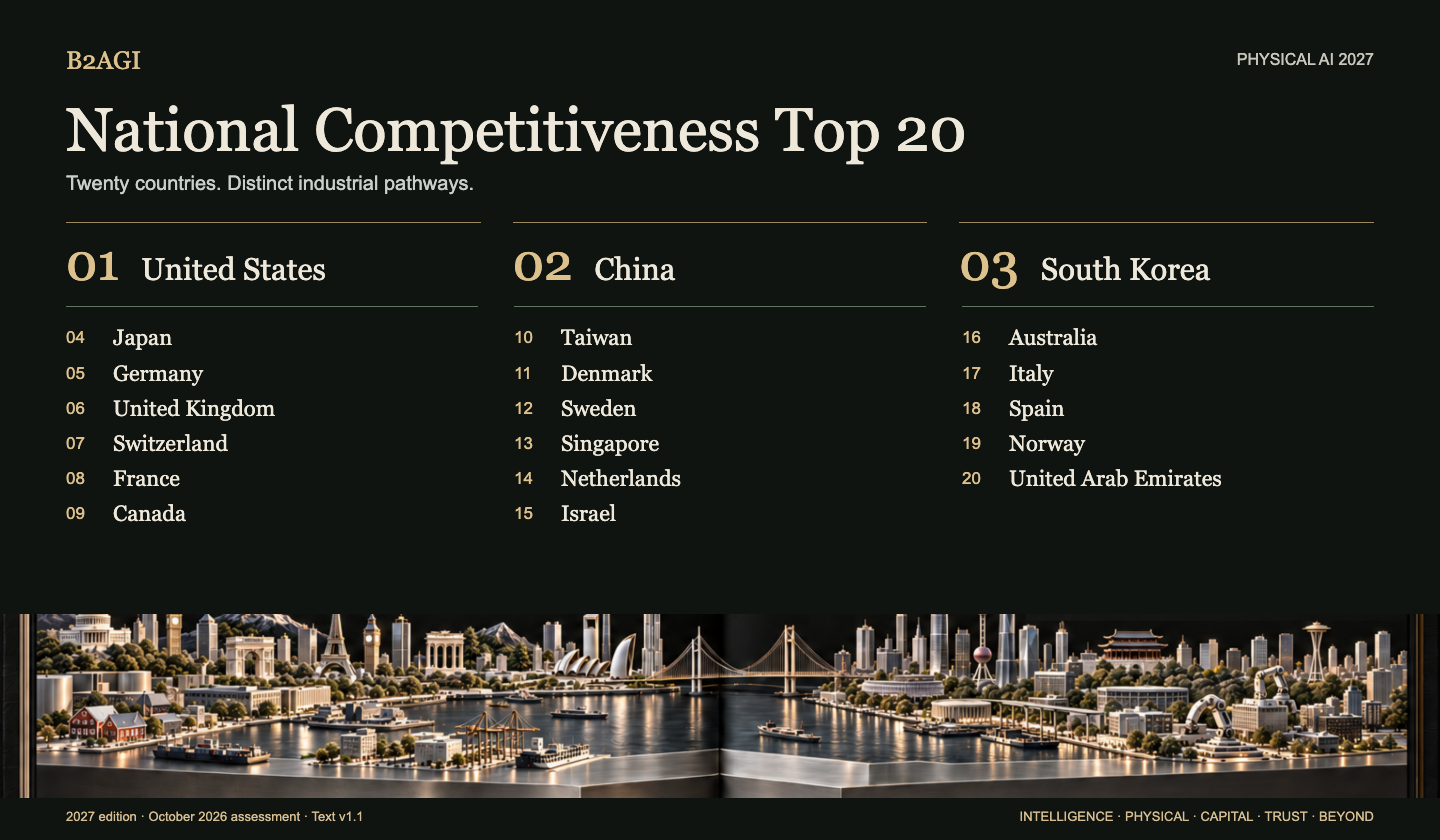
National competitiveness
2027 edition · 20 countries
1. United States
The United States brings general-purpose models and robotics platforms into named customer tasks, supported by growth capital and operating records.
Evidence and sources
IFR 2025 installation data, operating and customer records, technical platforms, completed financing and operating permissions.
2. China
China combines sensing, robot hardware and electronics manufacturing with product development and dense supply chains. Industrial-robot demand supports this manufacturing base.
Evidence and sources
IFR 2025 industrial-robot installations and domestic supplier share; manufacturer and customer records; research, financing, testing and shared development infrastructure.
3. South Korea
Korea combines research investment with NAVER's cloud-based robot coordination, KAIST's learned locomotion control and university-led robotics commercialization.
Evidence and sources
NAVER's internal operations; KAIST's July 2026 HOUND experiments and February 2026 report on technology-transfer and investment activity. The March 2026 testbed demonstration and planned external access retain separate stages. Economy-wide research indicators provide context.
4. Japan
Japan brings perception and motion generation into established manufacturing processes, building on robotics and precision-control capabilities.
Evidence and sources
JARA calendar-2025 production and shipments, IFR installations, robot-control and customer records. JARA includes dedicated manipulators; production and installation measures retain separate definitions.
5. Germany
Germany brings industrial customers, intelligent integration providers and external testing and approval into the same deployment pathway.
Evidence and sources
Manufacturing demand, customer-process integration, industrial fleets and testing services. Overseas customer installations retain their operating locations.
6. United Kingdom
The United Kingdom develops local robotics models and robot-learning hands through documented joint development.
Evidence and sources
Driving trials, DEX-EE and DemoStart research, model development, financing and reusable tools. Joint international research retains shared attribution.
7. Switzerland
Switzerland’s ANYmal brings learned control into industrial inspection workflows.
Evidence and sources
Learned inspection and locomotion, research-to-product transfer, institutional and financial context, with development and customer sites separately attributed.
8. France
France provides open robot-learning tools and develops general-purpose manipulation models alongside hardware integrations.
Evidence and sources
Warehouse implementations, robot-learning tools, manufacturing integration, financing and testing access. Joint French-US development retains shared attribution.
9. Canada
Canada develops physical manipulation learning, industrial tools and truck-OEM integration through distinct product pathways.
Evidence and sources
Industrial robot suppliers, shared research assets and supervised freight development. Waterloo and Toronto activity retain separate locations.
10. Taiwan
Taiwan combines semiconductor fabrication and packaging with R&D, robotics investment and industrial testing infrastructure.
Evidence and sources
NSTC 2024 R&D expenditure; TSMC fabrication and packaging; electronics and robotics records; ITRI testing and incubation infrastructure.
11. Denmark
Denmark supplies AMRs for transport and collaborative robots for AI greenhouse harvesting, with named customer tasks.
Evidence and sources
UR and MiR platform supply, Odense development infrastructure, DTI incubation and Danish industry records. National turnover and local cluster activity retain separate scopes.
12. Sweden
Sweden connects robotics research and industrial tasks through WARA Robotics and WASP doctoral training, alongside ABB development, ISO standards work and Hexagon's humanoid programme.
Evidence and sources
WARA's December 2024 industry-linked challenge and WASP's May 2026 graduate statistic; domestic ABB development and multinational Hexagon activity retain their locations. The new ABB campus is scheduled for 2027.
13. Singapore
Singapore brings foreign robot hardware into power-tunnel inspection through local integration and operation.
Evidence and sources
Power-tunnel inspection, retail integration, local operators, research and institutional context; country and cluster profiles cross-reference shared events.
14. Netherlands
The Netherlands combines a documented warehouse-automation installation with an automation-finance role serving an overseas site.
Evidence and sources
ASML equipment and R&D, domestic warehouse integration, testing services and separately located overseas automation finance.
15. Israel
Israel develops observation-based physical manipulation and driver-assistance technology, supported by research investment and national AI computing access for academia and industry.
Evidence and sources
Manipulation development, eyes-on SuperVision assistance and acquisition records. January 2026 national computing infrastructure is operational; accelerator allocations extend over subsequent years.
16. Australia
Australia hosts autonomous construction at a solar site and shared physical testing by public research teams.
Evidence and sources
Komatsu's September 2025 Australian operating fleet, Rio Tinto Pilbara rail and drilling, and a separately staged construction pilot.
17. Italy
Italy’s industrial robotics integration extends into Comau’s AI-enabled warehouse testing and validation for the European MASTERLY project.
Evidence and sources
IFR manufacturing installations, Italian automation supply and European testing infrastructure. Comau reported Decathlon warehouse validation on 9 September 2026; the customer warehouse location is not established by that release.
18. Spain
Spain hosts Barcelona robotics-platform development and an AI inspection development site.
Evidence and sources
Barcelona robot engineering, manufacturing robot demand, customer integration and shared European testing resources.
19. Norway
1X’s April 2024 announcement describes development of a Moss, Norway facility linking engineering, actuator manufacture, robot assembly and testing.
Evidence and sources
Company-reported manufacturing development in Moss, Norway, announced 2 April 2024. The cited announcement does not establish completion or current operating capacity.
20. United Arab Emirates
The UAE brings external autonomous-driving technology into local transport services. Dubai passenger-operation records support its adoption and operations role.
Evidence and sources
Dubai RTA’s passenger-service report dated 19 August 2026. Operational figures relate to the service period stated in that report; announced expansion and the 2030 transport target remain prospective.
All 390 records · JSON · Methodology